

Railway and Render are very good platforms for web apps. A Discord bot is not a web app. It never receives an HTTP request: it opens one outgoing WebSocket connection to Discord and holds it for days. That single difference decides how each free tier treats your bot, and what you pay to keep it online.
This comparison covers Railway, Render and Bot-Hosting for that one job. We run Bot-Hosting, so judge the facts, not the tone: every figure about Railway and Render comes from their own pricing pages and documentation, checked on 24 November 2026 and linked at the end.
The short answer
| Railway | Render | Bot-Hosting | |
|---|---|---|---|
| Free tier | $1 of usage a month, after a 30-day trial with $5 | Free web services, 750 instance hours a month | 256 MB of RAM, 25% of a core, one deployment |
| Is an idle bot stopped? | No, while it holds its connection to Discord | Yes, after 15 minutes without inbound traffic | No |
| What ends the free ride | The $1 of credit runs out | Background workers have no free plan | A missed renewal click, every 4 days |
| Cheapest always-on plan | Hobby, $5 a month, including $5 of usage | Background worker, $7 a month, 0.5 CPU and 512 MB | Starter, $2.29 a month, 1 GB of RAM and two deployments |
| How it is billed | By the second, for the RAM and CPU used | Fixed price per instance | Fixed price per plan |
Railway and Render list their prices in US dollars. Bot-Hosting prices are the ones the pricing page shows for your region, before VAT.
Railway: the bot stays awake, the credit does not last
The trial. A new account gets $5 of credit for 30 days, without a card, with up to 1 GB of RAM per service. When the 30 days pass or the $5 is spent, the services stop. Until you verify the account by connecting GitHub, a trial service has restricted outbound network access, and a bot needs that access to reach Discord.
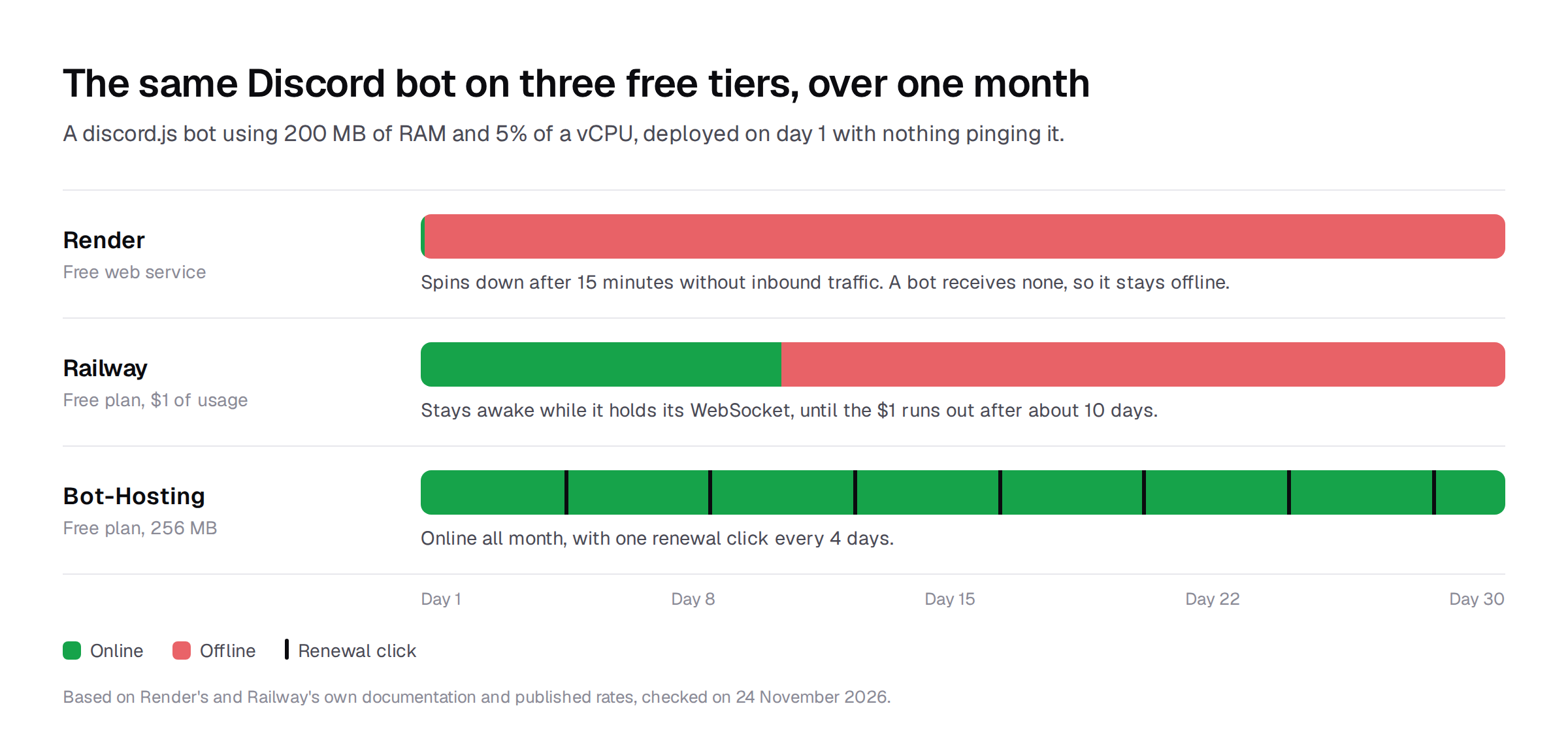
The Free plan. After the trial you can stay on a plan that costs nothing and includes $1 of usage a month. Its services are serverless: they sleep after 5 to 10 minutes without outbound traffic. That rule is good news for a bot. Railway’s own pricing page says that a bot holding a WebSocket keeps itself awake.
The catch. Usage is metered: $10 per GB of RAM per month and $20 per vCPU per month. Railway’s Free plan page gives the scale: $1 pays for 100 MB of RAM around the clock, or for 0.05 vCPU around the clock, not both. A bot that uses 200 MB of RAM and 5% of a vCPU costs $2 of memory and $1 of CPU, so $3 a month. The $1 lasts about ten days, then the services stop until the next billing cycle.
The paid plan. Hobby costs $5 a month and includes $5 of usage, with services that are always on. The same 200 MB bot stays within the included usage, so the bill is $5. A bot that uses 512 MB and 5% of a vCPU costs $6 of usage, and the bill is $6. For a paid plan, Railway asks for a post-paid card: prepaid cards are not accepted.
Pick Railway when the bot is one service in a larger project, with a dashboard, an API, a queue and a database that talk to each other, and you would rather pay for what runs than for a plan.
Render: the free tier is for web services
What is free. Render’s free instances exist for web services, static sites, Postgres and Key Value. Its documentation is explicit that other service types do not support free instances. A bot is a background worker, and a background worker starts at $7 a month for 0.5 CPU and 512 MB of RAM.
What happens if you deploy the bot as a free web service. Render spins down a free web service that goes 15 minutes without inbound traffic, and counts HTTP requests and WebSocket messages on existing connections. A bot’s connection to Discord is one the bot opens itself, towards Discord. Nothing comes in, so the instance spins down and the bot goes offline with it.
What about pinging it? Adding a small web server and an uptime monitor does keep the instance up. Here is what you are building on:
- A workspace gets 750 free instance hours a month. One service running all month uses up to 744 of them, so there is room for one bot, not two.
- Render’s documentation says it might restart a free web service at any time.
- A free web service has no persistent disk. Files are lost on a redeploy, a restart or a spin-down, so a SQLite database or a JSON file starts empty again.
- Render may suspend a free web service that initiates an uncommonly high volume of traffic over the public internet, and calling external APIs is one of its examples.
- A free Postgres database expires 30 days after it is created.
Render’s own summary of its free instances is “Do not use them for production applications.”
The paid plan. The $7 worker has a fixed price, prorated by the second, and never sleeps. A persistent disk is available on paid services, at an extra cost.
Pick Render when your project is first a web app or an API, with the bot as a worker next to it, and you want deploys from Git and managed Postgres in one place.
Bot-Hosting: built for a process that never stops
The free plan. 256 MB of RAM, 25% of a CPU core, 512 MB of storage and one deployment, without a card. There is no sleep timer, because nothing here depends on HTTP traffic. Files stay on the deployment between restarts and are backed up every hour.
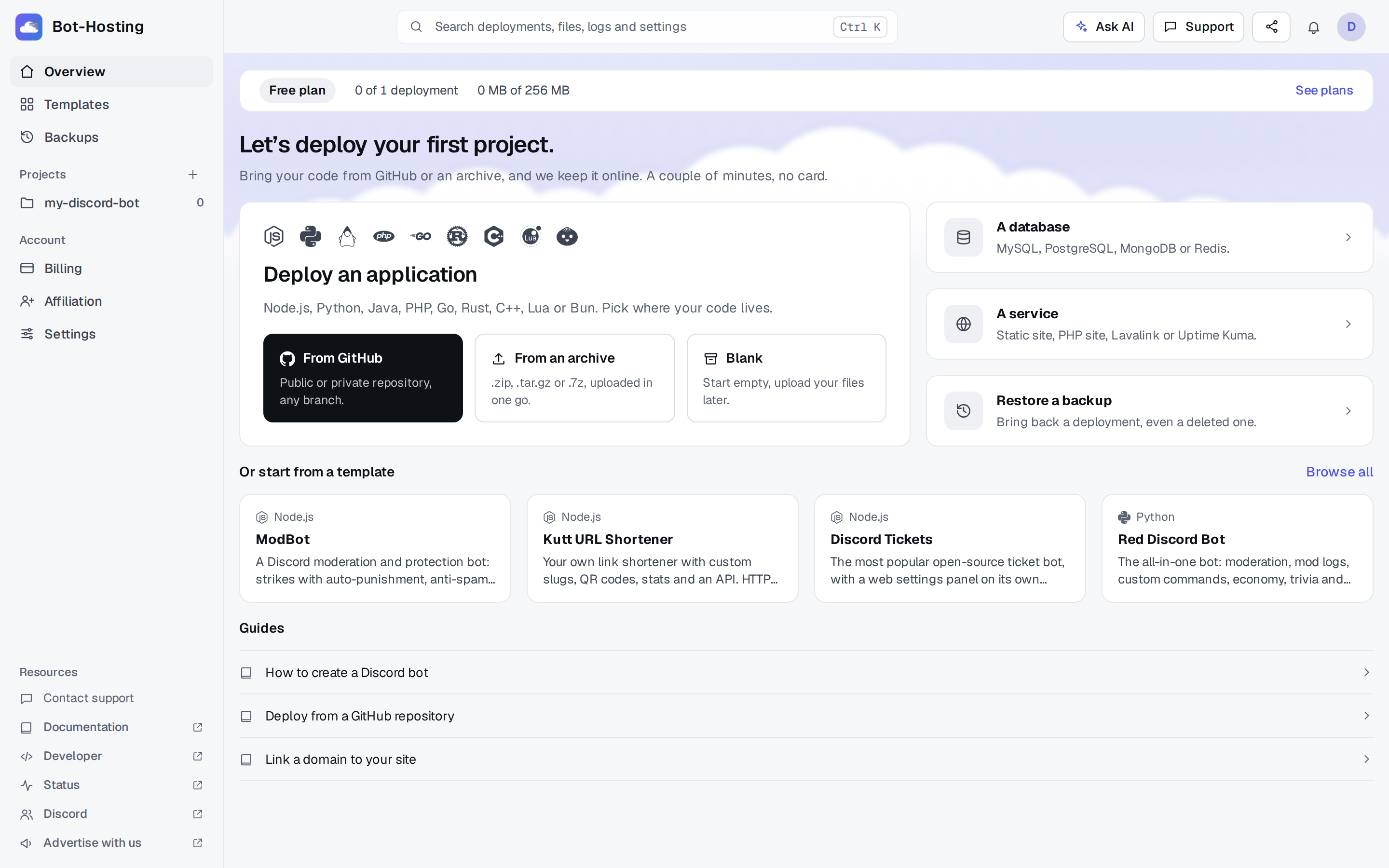
The catch. You renew the free plan by hand every 4 days, with one click in the dashboard. It stays free, and the click only proves that someone still uses the bot. If you miss it, the deployment is suspended until you renew, and deleted if you do not renew within 3 days.
The paid plans. Starter costs $2.29 a month: 1 GB of RAM, 50% of a core, 5 GB of storage and two deployments, so a bot and its database. Starter+ costs $3.39 a month for 2 GB of RAM, a full core, 8 GB of storage and four deployments. The price is fixed. A bot that uses more memory one month does not cost more: it stops at its limit and restarts.
What it does not do. There is no autoscaling and no bill by the second. A deployment is one container with fixed limits, on servers in Germany, Finland or the United States. Past what one process can handle, you split the bot yourself into shards and workers, which the guide to large bots covers.
Pick Bot-Hosting when the bot is the project, and you want it online for a fixed, low price or for free. The Discord bot hosting page lists what is included.
The same bot, three bills
Take a discord.js bot in a few dozen servers. It uses 200 MB of RAM and about 5% of a vCPU, and keeps its data in a SQLite file.
| What happens | Monthly cost | |
|---|---|---|
| Railway, Free plan | Runs about ten days, then stops until the next cycle | $0 |
| Railway, Hobby | Always on, usage of $3 within the included $5 | $5 |
| Render, free web service | Spins down after 15 minutes, and the SQLite file is not kept | $0 |
| Render, background worker | Always on, with a persistent disk to add for the SQLite file | $7 plus the disk |
| Bot-Hosting, Free | Always on, with a renewal click every 4 days | free |
| Bot-Hosting, Starter | Always on, renews on its own, room for a second deployment | $2.29 |
The Railway figures are arithmetic on its published rates: 0.2 GB at $10 and 0.05 vCPU at $20. Your own bot will differ, so read its memory use in your current host’s metrics before you compare.
Which one to pick
- The bot is the whole project: Bot-Hosting. A fixed price, or free if a click every 4 days does not bother you.
- The bot is one part of a larger system: Railway. Several services on a private network, billed for what they use.
- The project is a web app with a bot on the side: Render, on a paid worker. Its free tier is for the web service, not for the bot.
FAQ
Can I run a Discord bot on Render’s free tier?
Only as a web service that something pings to keep it awake, with the limits listed above: one bot per workspace, restarts at any time and no persistent files. Render’s background workers, the service type made for a bot, start at $7 a month.
Does Railway still have a free plan?
Yes. After the 30-day trial, the Free plan gives $1 of usage a month and does not expire. For a bot that uses more than about 100 MB of RAM, that credit runs out before the end of the month.
Do I need to change my code to switch?
No. On all three, the bot reads its token from an environment variable and starts with the same command. Moving to Bot-Hosting means a GitHub URL or a zip, then the token in the Environment tab. The GitHub deployment guide shows the steps.
What about Replit?
Replit no longer keeps a free bot online, and its documentation points bots to a Reserved VM. The Replit alternative guide has the details and the migration steps.
Sources
Checked on 24 November 2026:
- Railway: pricing, plans, Free plan and trial and serverless.
- Render: free instances, pricing, compute plans and persistent disks.
Prices and limits change. If one of these figures is out of date, the provider’s own page is the reference.